Monday, 15 June 2026

Life Beyond the Lab Report

 Life Beyond the Lab Report: Are We Monitoring Life More Than Living It?


Imagine waking up with a slight pain in your shoulder.


Twenty years ago, you would have stretched your arm, blamed your sleeping position, and continued your day.


Today, within ten minutes, you have searched twelve websites, diagnosed yourself with seven rare conditions, joined three online forums, and mentally prepared your farewell speech.


The shoulder, meanwhile, has already stopped hurting.


Modern humans have become experts at worrying. We monitor, track, calculate, compare, analyze, and discuss our bodies so much that sometimes we forget the original purpose of having one—to live.


Health matters. Taking care of yourself matters. But life is not an endless laboratory experiment. It is meant to be experienced, enjoyed, laughed through, and occasionally danced through, even if your knees make a sound when you stand up.


When Did Every Sensation Become a News Alert?


A slight headache.


A skipped heartbeat.


A random twitch.


A day of tiredness.


Somewhere along the way, many of us stopped treating these experiences as normal parts of being human and started treating them like emergency press conferences.


Our minds immediately gather evidence, summon experts (usually the internet), and prepare for the worst.


Ironically, while we are busy investigating life, life continues without us.


The birds outside are not discussing their oxygen levels.


The trees are not comparing blood pressure readings.


The river is not worried about whether its flow rate falls within the recommended range.


Nature simply participates in life.


Humans often pause participation until they receive complete reassurance.


Unfortunately, complete reassurance is one of the few things life never promises.


The Age of Numbers


Never before have people had access to so much information about themselves.


We count steps.


Track sleep.


Measure calories.


Monitor heart rates.


Analyze reports.


Compare results.


Review trends.


None of these tools are bad. In fact, many are incredibly useful.


The problem begins when the numbers become more important than the life they are supposed to support.


Imagine spending years polishing a car but never taking it for a drive.


The car may look spectacular.


The journey never happens.


Many people are becoming experts at maintaining life while forgetting to enjoy it.


Health Awareness vs. Health Obsession


There is a big difference between caring about your health and constantly worrying about it.


Health awareness says:


"I will take care of my body."


Health obsession says:


"I will monitor every sensation until I convince myself something is wrong."


One promotes well-being.


The other promotes anxiety.


The body is not a machine that produces identical readings every moment of every day.


Stress changes things.


Excitement changes things.


Exercise changes things.


Lack of sleep changes things.


Life changes things.


That is not failure.


That is biology.


What If the Goal Isn't Perfect Health?


Many people spend years waiting for the perfect report, perfect number, perfect diagnosis, perfect reassurance, or perfect certainty.


Meanwhile:


Children grow up.


Friendships drift.


Sunsets happen.


Conversations are missed.


Dreams are postponed.


Life quietly unfolds.


What if the goal is not perfect health?


What if the goal is building a meaningful life while caring responsibly for your health?


That question became the inspiration behind my new book:


Life Beyond the Lab Report: A Guide to Living Beyond Health Anxiety


In this book, I explore how modern life has transformed health awareness into health worry for many people and how we can rediscover balance, perspective, and peace of mind.


Through stories, reflections, humor, and the journey of an anxious king guided by a wise physician, the book invites readers to step beyond constant worry and reconnect with what truly matters.


📖 Life Beyond the Lab Report: A Guide to Living Beyond Health Anxiety


https://www.amazon.in/dp/B0H4WRY15L


A Gentle Reminder


Taking care of your health is wise.


Living in fear of every sensation is exhausting.


Medical care has its place.


Diagnostic tests have their place.


But laughter has a place too.


Friendship has a place too.


Purpose has a place too.


Joy has a place too.


A lab report can tell you many things about your body.


It cannot tell you whether you spent time with people you love.


It cannot tell you whether you laughed today.


It cannot tell you whether you appreciated a beautiful morning.


It cannot tell you whether you truly lived.


Those answers belong to you.


And perhaps the most important health decision we can make is remembering that life is bigger than the numbers.


Final Thought


The next time your body does something unusual, take a moment before turning it into a full-scale international investigation.


You may need medical attention.


Or you may simply need a glass of water, a good night's sleep, and less time on the internet.


Either way, don't forget to live while you're figuring it out.


Because life isn't happening after the report arrives.


Life is happening right now.


— Suma Adari

Author of Life Beyond the Lab Report: A Guide to Living Beyond Health Anxiety

Wednesday, 10 June 2026

Why Does Biochemistry Feel So Difficult? (And Why It Doesn’t Have to)


Why Does Biochemistry Feel So Difficult? (And Why It Doesn’t Have to)

Have you ever opened your biochemistry notes and wondered whether the pathways were designed by scientists or by someone who really enjoyed drawing arrows?

You’re not alone.

For many students, biochemistry feels like learning a new language while solving a puzzle and preparing for an exam at the same time. Glycolysis, enzymes, ATP, metabolism, the Krebs Cycle — sometimes it seems like every chapter introduces another set of terms waiting to challenge your memory.

The good news?

Biochemistry is not as impossible as it sometimes appears.

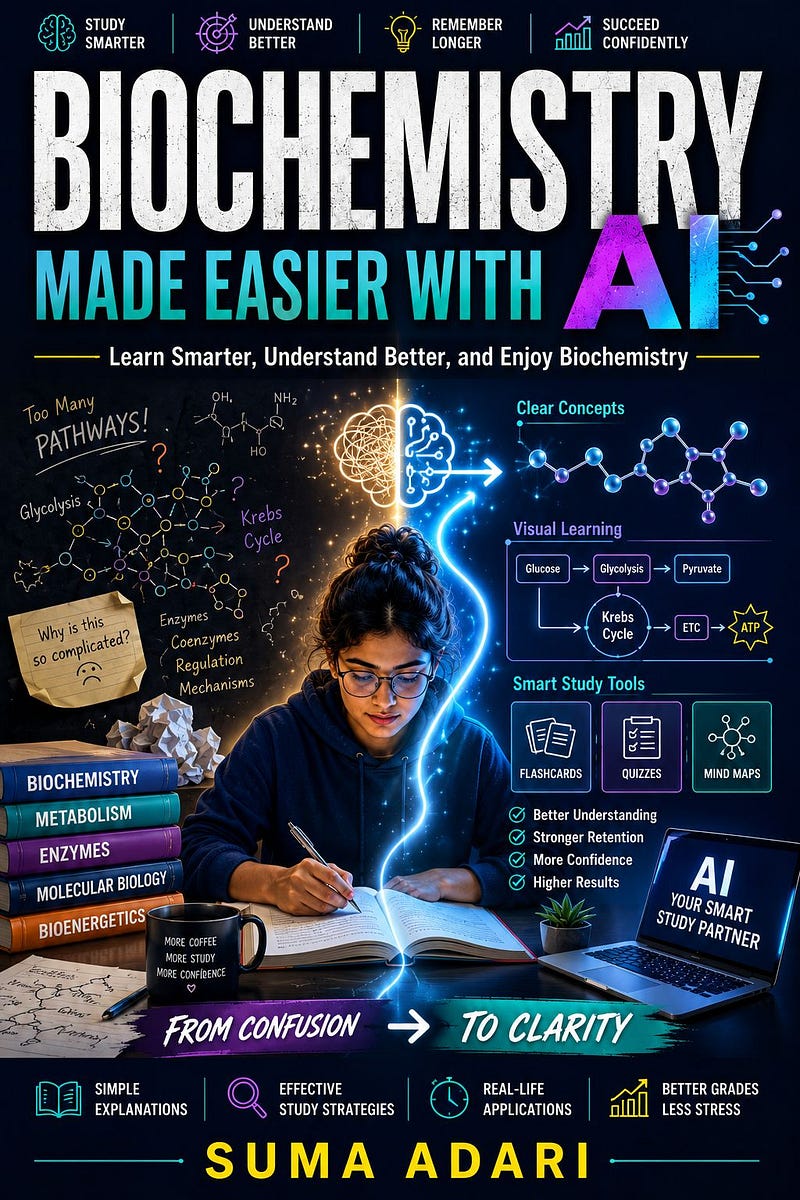
That’s exactly why I wrote Biochemistry Made Easier with AI: Learn Smarter, Understand Better, and Enjoy Biochemistry.

Biochemistry Made Easier with AI: Learn Smarter, Understand Better, and Enjoy Biochemistry 
 https://amzn.in/d/06AcKWZH

This book isn’t about replacing hard work with technology. Students have successfully learned biochemistry for decades without AI. Instead, it’s about discovering smarter ways to study, understand complex concepts, and reduce unnecessary stress.

Inside the book, you’ll find simple explanations, relatable examples, practical study tips, interactive activities, and ethical ways to use AI as a learning companion. No complicated jargon. No intimidating textbook language. Just a friendly guide designed to help students feel more confident about biochemistry.

Whether you’re a Biochemistry, Biology, Biotechnology, Nursing, Medical, or Pharmacy student, this book aims to turn confusion into understanding — one concept at a time.

Because learning biochemistry shouldn’t feel like solving a mystery every day.

And remember:

AI may be the bicycle, but you’re still the rider.

Happy learning!

— Suma Adari

Love vs. Admiration


The Two Feelings That Have Confused Humanity for Generations

There comes a point in life when we look back and smile.

Not because everything went according to plan.

But because some people entered our lives and changed us forever.

Sometimes they stayed.

Sometimes they left.

And sometimes they never even knew the impact they had on us.

That is where the story of love and admiration begins.


Have You Ever Been Inspired by Someone?

Of course you have.

We all have.

A teacher who believed in us.

A friend who encouraged us.

A colleague who motivated us.

A person whose confidence, talent, kindness, or determination made us think,

"I want to become better."

The funny thing is that sometimes admiration arrives so quietly that we mistake it for love.

And honestly, who can blame us?

The heart is not always interested in labels.


The Human Brain Is a Wonderful Story Writer

Someone smiles at us twice.

Our brain writes ten chapters.

Someone appreciates our work.

Our brain starts planning the sequel.

Someone inspires us.

And suddenly they become the main character in a story they don't even know exists.

Human beings are creative.

Very creative.

Sometimes too creative.


Not Every Important Person Is Meant to Stay

This is one of life's most beautiful lessons.

Some people enter our lives to walk beside us.

Others enter our lives to point us in a direction.

The difference is important.

A lighthouse does not travel with the ship.

Yet without the lighthouse, the ship may never find its way.

Think about that for a moment.

How many people guided your journey without becoming part of your destination?


The Success We Forget to Celebrate

Many people spend years thinking about one person they couldn't have.

Meanwhile, they build careers.

Raise families.

Write books.

Start businesses.

Help others.

Learn.

Grow.

Overcome.

Achieve.

Yet they continue staring at one closed door while standing inside a house they built themselves.

Life has a gentle sense of humor sometimes.


Admiration Is Not a Lesser Feeling

Somehow society convinced us that admiration is what remains when love does not happen.

I disagree.

Admiration has built dreams.

Admiration has created inventions.

Admiration has inspired leaders.

Admiration has encouraged ordinary people to attempt extraordinary things.

Every successful person was inspired by someone.

A teacher.

A mentor.

A role model.

A parent.

A friend.

Admiration is not small.

It is powerful.

Quietly powerful.


The Question That Changed My Perspective

Instead of asking:

"Why didn't that relationship happen?"

What if we asked:


"What did that person help me become?"

Suddenly everything changes.

The focus shifts from loss to growth.

From disappointment to gratitude.

From endings to impact.

And impact is often far more valuable than we realize.


Life Is Not a Collection of Possessions

People are not trophies.

Relationships are not certificates.

Success is not measured by how many people stayed.

Success is measured by how much we learned, how much we grew, and how much we contributed.

Some people stay for a chapter.

Some stay for a lifetime.

Both can leave a legacy.


A Small Thought Before You Leave

Think about someone who inspired you.

Someone you admired.

Someone you may have loved.

Now ask yourself:

If you had never met them, would you be exactly the same person today?

Probably not.

And perhaps that is the real gift.

Not that they stayed.

Not that they left.

But that they helped shape the person you became.

And honestly, that's a beautiful thing.

This topic can be deeply connected in the book 


LOVE VS ADMIRATION: The Invisible Line Between the Heart and the Mind 
 https://amzn.in/d/074FycVB


Final Thought

Love connects hearts.

Admiration awakens possibilities.

When we understand the difference, we stop mourning every unfinished story and start appreciating every life that helped write our own.

Because sometimes the greatest gift a person gives us is not their presence.

It is the person we become because of them.


Monday, 4 May 2026

Can We Reverse Ageing?


The Science of Longevity, Genes, and the Future of Human Life

 Is My Body Just Updating Without Permission?

One day, you’re young, energetic, and dancing without pain.

The next day:

Your knee makes popcorn sounds
Your back sends warning messages
And you make strange noises just by standing up.

Ageing is truly humanity’s most unexpected plot twist.

Honestly, mentally, most of us still feel 21.

But physically?

Our bodies sometimes behave like old Wi-Fi routers struggling to reconnect.

Me: “Why is my back hurting?”
My body: “Because you slept.”
Me: “Fair enough.”

Which raises an interesting question:

Can science actually slow down ageing… or even reverse it?

That question led me into the fascinating world of:

longevity science
stem cells
regenerative medicine
gene editing
artificial intelligence in healthcare
and the truth behind anti-ageing claims flooding the internet.

In my book Can We Reverse Ageing?, I explore:
✅ Why humans age
✅ What happens inside our cells
✅ How stress, sleep, food, and lifestyle affect ageing
✅ whether stem cells and future medicine can help humans live healthier, longer
✅ and why some “miracle anti-ageing secrets” belong more in comedy shows than science labs.

Scientist: “Ageing is a complex biological process.”
Internet Influencer: “Drink this green juice and become immortal.”
Scientist: “That’s… not how cells work.”

The best part?

This isn’t a boring medical textbook.

It’s a simple, engaging, and eye-opening journey into one of humanity’s biggest questions:

How can we live longer… without feeling older emotionally, physically, and mentally?

Because honestly, if science can help humanity age better while also saving us from random back pain while picking up a spoon…

That would already be a historic achievement.

Me: “I need anti-ageing solutions.”
Doctor: “Sleep early.”
Me: “I was expecting futuristic technology.”
Doctor: “Start with vegetables.”

And until then:

sleep properly
drink water
reduce stress
And never trust an influencer selling “eternal youth detox tea” from a beach.

Your cells deserve better.

https://www.amazon.in/dp/B0GY4MT37C


📘 Can We Reverse Aging?
The Science, Myths, and Future of Staying Younger Longer

By Suma Adari


Monday, 6 April 2026

Perfectly Updated, Emotionally Outdated

 An Aesthetic Life, A Silent Heart, and the Journey Back to Something Real


We have never looked better.
And we have never felt this disconnected.

Our lives are beautifully arranged.
Clean aesthetics. Soft lighting. Perfect angles.
We document everything—except what we actually feel.

We reply fast.
We react instantly.
We stay “connected.”

And yet…
Why do conversations feel empty?
Why does silence feel louder than ever?
Why does happiness look real online—but feel borrowed offline?

This is not a crisis you can post about.
This is something quieter.
More personal.
More uncomfortable.

We are becoming strangers to our own emotions.

Welcome to the world of being perfectly updated… but emotionally outdated.


There was a time when moments were lived, not captured.
When laughter didn’t need proof.
When the connection didn’t depend on notifications.

Now?

We measure worth in views.
We translate feelings into captions.
We perform emotions instead of experiencing them.

We didn’t lose depth because we are weak.
We lost it because we adapted too well to a world that rewards appearance over authenticity.

And slowly, without realising it,
We built lives that look full… but don’t feel whole.


This book is not here to judge you.
It’s here to find you.

https://www.amazon.in/dp/B0GTPMBHYJ


“Perfectly Updated, Emotionally Outdated” is a quiet wake-up call.

Not loud.
Not preachy.
But honest enough to make you pause.

It speaks about:

  • The hidden loneliness behind constant connectivity
  • The exhaustion of always being “visible”
  • The gap between how we present ourselves and how we actually feel
  • The emotional numbness we normalise
  • And the forgotten art of simply being… without performing

But more than anything,
It offers something rare in today’s world:

A way back.

Back to real conversations.
Back to uncomfortable honesty.
Back to emotions that don’t need editing.


Because the truth is—

You don’t need a more aesthetic life.
You need a more honest one.

You don’t need more attention.
You need more connections.

You don’t need to update your image.
You need to reconnect with your inner voice.


If you’ve ever felt like your life looks right… but feels wrong,
If you’ve ever smiled for a photo while feeling empty inside,
If you’ve ever been surrounded by people but still felt alone—

This book will feel like someone finally understood what you couldn’t explain.


Maybe it’s time we stop upgrading everything outside…
and start reconnecting with what’s been quietly waiting inside us.

Not for the world to see.
But for us to finally feel.

Sunday, 15 March 2026

The Hidden Stage Before Diabetes: When Your Cells Stop Listening to Insulin


The quiet metabolic warning most people miss until their blood sugar starts rising.


Let's imagine knocking on someone’s door with a food delivery.


You ring the bell once.
No answer.

You ring again.
Still nothing.

Now imagine doing this every day… for years.
That is exactly what insulin is doing inside your body.

And one day, exhausted, the delivery system collapses.
Doctors call that diabetes.

But the real story began much earlier — with something quieter, sneakier, and very common.
Insulin resistance.

First, Meet Your Body’s Energy Manager


Whenever you eat, your body breaks food down into glucose — the fuel your cells use to produce energy.
Now comes the key hormone responsible for this process: insulin.

,Think of insulin as the delivery executive carrying energy packets and knocking on your cell doors.
“Hello! Energy delivery!”
Normally, the cells open quickly and say:
“Great! Come in!”
Energy flows in smoothly, and everyone is happy.

But sometimes…
Your cells start acting like teenagers wearing headphones.
They hear the knock.
But they pretend not to.
That awkward moment is called insulin resistance.


What Exactly Is Insulin Resistance?


In simple words:
Your body still produces insulin.
Sometimes even more than normal.
But the cells respond like this:
“Hmm… maybe later.”
So glucose stays in the bloodstream longer.

The pancreas (your insulin factory) sees the problem and says:
“Fine. I’ll send MORE insulin!”
For years, the pancreas works overtime trying to keep blood sugar normal.
This is why many people have insulin resistance for a long time without knowing it.

Your body is quietly working harder behind the scenes.
So, When Does Diabetes Enter the Scene?

Imagine an employee working double shifts for years.
Eventually, they burn out.
That’s what happens to the pancreas.
After years of overproducing insulin, the pancreas gets tired and can no longer keep blood sugar under control.
That’s when doctors diagnose Type 2 diabetes.

So the real timeline usually looks like this:
Insulin resistance → Prediabetes → Diabetes
It’s not a sudden accident.
It’s a slow metabolic story.
The Fasting Blood Sugar Clue
Doctors often check fasting blood glucose after about 8 hours without food.

Here’s the basic guide:

Fasting Sugar Meaning

Below 100 mg/dL Healthy range

100–125 mg/dL Prediabetes

126 mg/dL or higher: Possible diabetes

But here’s something most people don’t know.
You can have insulin resistance even when fasting sugar looks normal.
Yes.

Your body may be struggling quietly while the lab report still looks polite.
Signs Your Body Might Be Struggling
Before a disease appears, the body usually sends small signals.
Unfortunately, most of us mistake them for “normal tired life.”

Some clues include:
• Feeling sleepy after meals
• Constant cravings for sweets
• Belly fat that refuses to leave
• Brain fog or lack of concentration
• Getting hungry again very quickly
• Dark skin patches around the neck or underarms
These aren’t random annoyances.
They’re often metabolic whispers.

Your body is politely saying:
“Something in the energy system needs attention.”

When Diabetes Symptoms Appear


When blood sugar rises for long periods, the signals become louder:
• Frequent urination
• Constant thirst
• Blurred vision
• Slow wound healing
• Tingling in hands or feet

At this stage, the body has stopped whispering.
It’s now sending urgent messages.
The Part Most People Don’t Expect

Here’s the encouraging truth.
In many cases, insulin resistance can improve dramatically with lifestyle changes.
No miracle cures.
Just consistent habits.
Your metabolism responds surprisingly well to simple routines.

Small Things That Help Your Cells Listen Again


Move Your Muscles
Muscles love using glucose.
Walking, dancing, cycling, or yoga help your body burn glucose without huge amounts of insulin.
Even a 30-minute walk daily can make a difference.
Your muscles become more cooperative.

Eat Food That Looks Like Food


The body handles natural foods far better than highly processed ones.

vegetables
fruits
whole grains
nuts
proteins

Foods that arrive in shiny packets with 20 ingredients you cannot pronounce tend to confuse metabolism.

Your pancreas prefers simplicity.

Sleep Like It Matters (Because It Does)
Sleep deprivation increases stress hormones and worsens insulin resistance.
Aim for 7–8 hours of good sleep.
Your metabolism performs major repairs during sleep.
Calm the Stress Storm
Chronic stress increases the hormone cortisol.
And cortisol loves raising blood sugar.

Small habits help:
deep breathing
short walks
quiet moments without screens
Sometimes the best medicine is simply slowing down.

Things Your Metabolism Really Dislikes


 Sitting for long hours
 Sugary drinks every day
 Poor sleep routines
 Constant stress
 Heavy late-night meals

Your body prefers rhythm — not chaos.
The Thought That Changes Everything
Most people believe diseases appear suddenly.
But the body rarely works that way.
Your metabolism usually sends signals years before diagnosis.
Fatigue. Cravings. Belly fat. Sleep problems.
These are not just lifestyle inconveniences.
They’re messages from your internal energy system.
And the beautiful part?
If we listen early, the body often responds remarkably well.

Share-Worthy Reflection


Here’s something worth remembering:
Your body is not trying to punish you.
It’s trying to protect you.
Insulin resistance isn’t an enemy.
It’s more like a warning light on the dashboard.
The problem isn’t the warning light.
The problem is when we cover it with tape and keep driving.
So the next time your body whispers through fatigue, cravings, or strange energy crashes…
Pause.
Listen.

Because long before the disease appears,
Your body is quietly asking for care, balance, and attention.
And when we respond early,
our metabolism often says something beautiful back:

“Thank you.

Saturday, 7 February 2026

Understanding Perimenopause

 Why Symptoms Appear When Life Is Already Busy


Life does not slow down in midlife.


Responsibilities increase.
Expectations grow.
Time feels shorter, not longer.

Most women reach their late 30s or early 40s already carrying full days of work, family, care for others, constant decisions, and little space for rest. It is in the middle of this already busy life that perimenopause begins.

Clearly enough to be noticed.


Why This Phase Feels Unexpected

Perimenopause is rarely discussed in everyday conversations. Unlike puberty or pregnancy, there is no clear beginning, no fixed age, and no single symptom that announces its arrival.

Instead, it appears as small changes:

  • sleep that feels lighter

  • emotions that react faster

  • a heart that occasionally beats quicker

  • cycles that shift without warning

  • a mind that feels slightly less sharp than before

Because these changes arrive gradually, many women do not recognise them at first. They assume stress, overwork, or fatigue. Only when symptoms repeat does confusion begin.


When Medical Tests Are Normal but the Body Feels Different

One of the most unsettling parts of perimenopause is this contradiction:
Medical reports often come back normal, yet the body feels unfamiliar.

This happens because perimenopause is not a disease. It is a hormonal transition.

Hormones do not stop suddenly. They fluctuate — sometimes daily, sometimes monthly. These fluctuations affect the nervous system, sleep patterns, emotional regulation, and even how the body perceives normal sensations.

The body becomes more sensitive.

Sensitivity does not mean something is wrong.
It means the system is adjusting.


Why Symptoms Feel Stronger in Today’s Life

Perimenopause has always existed. What has changed is the environment in which women experience it.

Modern life rarely allows true rest:

  • screens stay on late

  • minds stay active even at night

  • stress becomes constant rather than occasional

The nervous system is already working hard. When hormonal fluctuations are added, the body reacts more noticeably.

This is why symptoms often feel intense — not because the phase is dangerous, but because the system is already stretched.


Why Panic Is Common — and Often Unnecessary

Many women begin to worry not because symptoms are severe, but because they are unfamiliar.

Unfamiliar sensations trigger fear quickly. The mind searches for explanations, often finding alarming information instead of reassurance.

But most perimenopausal symptoms are:

  • temporary

  • fluctuating

  • non-progressive

  • manageable with understanding

When women learn what is common in this phase, fear begins to soften.

Understanding creates calm.
Calm allows the body to settle.


This Is Not a Breakdown. It Is a Transition.

Every major life stage involved change.

Childhood changed into adolescence.
Adolescence changed into adulthood.

Perimenopause is another transition — one that happens quietly, without ceremony, while life continues at full speed.

The body is not failing.
It is reorganising.

And, as with all transitions, it calls for patience rather than pressure.


Why Clear Information Matters

Perimenopause does not need fear-based narratives.
It needs clarity.

When women understand:

  • why symptoms appear

  • Which changes are common

  • When reassurance is enough

  • When medical advice is truly needed,

they regain trust in their bodies.

This understanding turns confusion into confidence.


A Calm Reminder

Life may already be busy when perimenopause arrives, but this phase is not here to compete with your life. It is here to adjust the system that has supported you for decades.

With the right understanding, this phase becomes manageable — even gentle.

And most importantly, it becomes less frightening.


If you are looking for a calm, clear explanation of perimenopause — without panic, exaggeration, or medical overload — this conversation matters.

Because understanding changes everything.


A Gentle Note

If this explanation feels reassuring or familiar, it may help to know that this article is part of a larger, carefully written guide that explores perimenopause in calm, simple language — without fear, exaggeration, or pressure.

A Calm Guide to Perimenopause, this is the guide available on Amazon kindle.

https://www.amazon.in/dp/B0GM7N9MW4


The book looks at the full range of changes women may experience, explains why they happen, and helps distinguish between what is common and what truly needs medical attention. Its purpose is not to diagnose or treat, but to restore clarity and confidence during this natural life phase.

Sometimes, understanding is the most powerful form of reassurance.

Understanding does not remove all sensations — 
 It removes the fear attached to them.


Friday, 23 January 2026

The Vitamin D & B12 Paradox

 Why Are We Still Deficient Despite Doing Everything Right?

We live in a sunny country.
We eat “healthy.”
We take supplements.
And yet… many of us are still tired, foggy, low on energy, or just not feeling like ourselves.

So what’s going on?

This question is what led me to write The Vitamin D & B12 Paradox.

 The Sunny Country Irony

Vitamin D deficiency in countries like India sounds almost ridiculous at first. How can people surrounded by sunlight still be deficient?
Similarly, Vitamin B12 deficiency shows up even in people who eat well and take supplements.

The truth is uncomfortable but important:
Deficiency is not always about a lack of intake.

 It’s Not Just What You Consume — It’s What Your Body Can Use

Modern research shows that vitamin deficiency can persist due to:

  • poor absorption

  • conversion problems in the liver or kidneys

  • gut health issues

  • chronic stress and inflammation

  • receptor resistance at the cellular level

In other words, your blood reports may look “normal,” but your cells may still be starving.

 When “Normal” Reports Don’t Match How You Feel

Many people hear this sentence from doctors:

“Your reports are normal.”

And yet they still feel exhausted.

This book explores why that happens — using simple language, relatable stories, a bit of humour, and solid science — without turning it into a medical textbook.

 What This Book Is (and Isn’t)

This is not a quick-fix supplement guide.
It’s a body-awareness guide — helping you understand how Vitamin D and B12 actually work inside you, and what blocks them from doing their job.

If you’ve ever felt:

  • tired without a clear reason

  • mentally foggy

  • emotionally drained

  • frustrated with “doing everything right”

This book might give you clarity you didn’t know you were missing.

✨ Sometimes, the problem isn’t that your body is failing you.
✨ It’s that no one explained how it truly works.

The Vitamin D & B12 Paradox is now available on Amazon Kindle.

https://www.amazon.in/dp/B0GJG2RK6K


Tuesday, 20 January 2026

The Academy of Lost Stars

 A Place for Those Who Forgot How Bright They Are


Somewhere between responsibilities, expectations, and survival, many of us lose touch with our inner light.
The Academy of Lost Stars was born from that quiet truth.

This story is not just about magic, mystery, or an imagined academy hidden from the world. It is about people who feel lost, unheard, or unsure of their own worth—and the gentle journey of finding themselves again.

At the Academy, “lost” is not a failure.
It is a beginning.

Each character carries invisible scars—self-doubt, fear, unfulfilled dreams, and the weight of being “strong” for too long. The Academy doesn’t erase their struggles. Instead, it teaches them how to understand their past, accept their present, and believe in a future they once thought impossible.

Why stars?

Because stars don’t disappear when clouds cover them. They only wait.

This book is for:

  • The quiet dreamers who were told to be practical

  • The adults who still feel like uncertain children inside

  • Anyone who feels they are running… but not arriving

  • Anyone who needs a reminder that they are not broken—just becoming


The Academy of Lost Stars blends imagination with emotional truth, making it a comforting read for both young minds and grown hearts. It invites readers to slow down, reflect, and reconnect with the parts of themselves they may have abandoned.

If you’ve ever felt lost, maybe this story was written for you and you can access it here :

https://www.amazon.in/dp/B0GHSY349Y

Because even lost stars still shine. 🌟

Thursday, 8 January 2026

Jaggery vs Sugar: Same Sweetness, Very Different Stories Inside Your Body

 Jaggery vs Sugar: Same Sweetness, Very Different Stories Inside Your Body

Because not all sweetness behaves sweetly once it enters us.

Let’s admit it.

At some point in our lives, we’ve all heard this line from someone wise, old, or confidently loud:

 “Don’t eat sugar. Use jaggery—it’s healthy.”

And we nod.

Then proceed to add three spoons of jaggery into tea, feeling instantly virtuous, like we just did yoga for the liver.

But pause.

Is jaggery really better than sugar?

Or is it just sugar wearing a traditional outfit?

Let’s talk—honestly, scientifically, and without killing the sweetness of the conversation.


First, Let’s Meet the Two Sweet Culprits

 White Sugar – The Refined Healthy Queen

Sugar is extracted, purified, bleached, crystallized, and stripped of almost everything except pure sucrose.

Think of it as:

Sugar after attending a strict finishing school—polished, empty, and emotionally unavailable.

It gives:

Instant energy 

Instant blood sugar spike 

Instant crash 

Long-term drama (if overused)


 Jaggery – The Rustic Overachiever

Jaggery is made by boiling sugarcane juice (or palm sap) and not over-processing it.

Translation?

It still carries:

Iron

Magnesium

Potassium

Trace minerals

A little bit of its natural soul

It’s not perfect—but it’s less emotionally toxic.


What REALLY Happens Inside Your Body After You Eat Them

Let’s do a body-level walkthrough 


 In the Brain

Sugar:

Triggers dopamine spikes → cravings → “just one more bite” syndrome.

Jaggery:

Slower release → fewer cravings → less mental rollercoaster.

Your brain prefers steady affection, not sugar’s hot-and-cold relationship.


 In the Blood

Sugar:

Rapid glucose spike → insulin surge → crash → hunger → repeat.

Jaggery:

Slower absorption due to minerals → gentler insulin response.

Still raises blood sugar—but doesn’t slap your pancreas.


 In the Heart

Sugar overload:

Linked to inflammation, insulin resistance, and metabolic stress.

Jaggery (in moderation):

Minerals help reduce oxidative stress slightly.

Keyword: moderation, not mythology.


 In the Gut

Sugar:

Feeds bad gut bacteria → bloating, cravings, mood swings.

Jaggery:

Traditionally known to support digestion and bowel movement.

Grandmothers were onto something—just not unlimited laddoos.


 Iron Levels (Especially for Women )

Sugar: Zero contribution. Just vibes.

Jaggery: Small but helpful iron content—not a supplement, but a support.

No, it won’t cure anaemia—but it won’t ignore it either.


The Big Myth: “Jaggery Is Healthy, So I Can Eat More”

Let’s clear this gently but firmly.

🚫 Jaggery is NOT calorie-free.

🚫 Jaggery is NOT diabetic-safe in excess.

🚫 Jaggery is NOT a detox angel.

It is still sugar, just with better manners.

Think of it like this:

Sugar is a loud guest who overstays.

Jaggery is a polite guest—but still eats your snacks.


So… Should We Switch Completely?

Here’s the grown-up answer (boring but true):

✔️ Choose jaggery over refined sugar

✔️ Reduce total sweetness overall

✔️ Respect portion size

❌ Don’t overestimate it

Health is not about replacement only.

It’s about reduction + awareness.


Smart Ways to Use Jaggery Without Fooling Yourself

Use it in tea occasionally, not daily addiction

Prefer dark, unrefined jaggery

Avoid mixing jaggery and sugar together (yes, that defeats the purpose)

Pair it with fiber-rich foods

Let sweetness be a guest, not a roommate


Final Sweet Truth (No Sugar-Coating Here)

Jaggery doesn’t make you healthy.

Your habits do.

But jaggery:

✔ Is less processed

✔ Offers trace nutrients

✔ Is kinder to metabolism

✔ Respects tradition and science equally

So yes—

jaggery is better than sugar.

But better doesn’t mean limitless.

Because even good things, when overdone, turn into lessons.

Final Thought

“Choose sweetness with awareness—your body remembers every choice.”

“Better choices, gentler metabolism, healthier days.”

Author’s Note (Because This Is My First Blog of the Year,2026 )

This year, I’m choosing awareness over assumptions,

science over trends,

and balance over extremes—

even when it comes to sweetness.

Let’s eat smart, live real, and laugh a little while learning.

— Suma Adari


Sunday, 21 December 2025

World Meditation Day: What Years of Sitting With the Mind Has Taught Me

 Meditation doesn’t change life. It changes the person living it.

“Meditation isn’t escaping life. It’s meeting it.”


Meditation doesn’t make life quieter.
It makes you stronger inside the noise.

Sit. Breathe. Return.

      Most people don’t quit meditation because it doesn’t work.

      They quit because it works too honestly.


On World Meditation Day (21 December), instead of glorifying silence or selling serenity, I want to talk about what meditation actually does — to the mind, the body, and the very human chaos we carry every day.

Photo by Gaby Aziz on Unsplash

Meditation Is Not About Calm — It’s About Capacity

When I began training myself , the most common complaint I heard was:

“My mind is too noisy. I’m bad at meditation.”

That’s like saying, “My muscles ache, so exercise isn’t for me.”

Meditation doesn’t stop thoughts.

It builds your capacity to sit with them without being dragged around by them.

Neuroscience backs this up.

Research from Harvard Medical School shows that regular meditation thickens the prefrontal cortex (responsible for focus and decision-making) and reduces activity in the amygdala, the brain’s fear and stress center.

(Source: Harvard Gazette — Mindfulness & Brain Structure)

Photo by Topique SL on Unsplash


In simple words:

Meditation doesn’t remove stress.

It trains your nervous system not to panic every time stress knocks.

A Real Example: The Sleepless Doctor


One of our long-term peer trainee batch, was a medical professional — brilliant, disciplined, and exhausted.

She didn’t come to meditation for peace.

She came because she hadn’t slept properly in years.

She was suggested to start with short sessions. Just 7 minutes of breath awareness before bed.

After 3 weeks, she told me something important:

“My problems didn’t reduce.

But my body stopped fighting the night.”

This is not magic. It’s physiology.

According to the National Institutes of Health (NIH), meditation activates the parasympathetic nervous system, lowering cortisol levels and improving sleep quality.

(Source: NIH — Meditation and Stress Reduction)

Your body heals better when it feels safe.

Meditation teaches safety from the inside.

Meditation and the Body: More Than Mental Health


Many still believe meditation is only for emotional well-being. That’s outdated thinking.

According to the World Health Organization (WHO), chronic stress contributes to:

Heart disease

Diabetes

Autoimmune flare-ups

Digestive disorders

Meditation helps regulate:

Blood pressure

Heart rate variability

Inflammatory markers

A large review published in JAMA Internal Medicine found that mindfulness meditation significantly reduces symptoms of anxiety, depression, and chronic pain.

(Source: JAMA Internal Medicine, 2014)

I’ve seen this play out repeatedly:

People come for peace.

They stay because their body starts cooperating again.

Another Human Moment: The “I Don’t Have Time” Parent


A parent once told me:

“I can’t meditate. My life is too busy.”

She was asked to try this:

One conscious breath before answering their child.

That’s it.

Weeks later, they said:

“I still shout sometimes.

But now I notice it before it explodes.”

That pause — that single breath — is meditation in real life.

Meditation is not a posture.

It’s a pause between impulse and reaction.

What Meditation Really Gives You

Not constant happiness.

Not spiritual superiority.

It gives you:

Awareness before damage

Space before regret

Breath before burnout

The United Nations, which officially observes World Meditation Day (21 December), recognizes meditation as a universal practice that supports mental health, emotional balance, and social well-being across cultures.

(Source: United Nations — World Meditation Day Observance)

Why the World Needs Meditation Now


The United Nations, in recognising World Meditation Day, described meditation as a universal, inclusive practice that supports inner peace and collective well-being, across cultures and belief systems.

We live in an age of constant stimulation:

Notifications

News cycles

Performance pressure

Meditation doesn’t disconnect you from reality.

It reconnects you to yourself inside reality.

How to Begin (Without Ruining It)

Photo by Flavien Beauvais on Unsplash


Forget perfection.

Forget long sessions.

Start here:

Sit comfortably

Breathe naturally

Notice what arises

Return to the breath

Even 5 minutes a day can rewire how your body responds to life.

Consistency matters more than duration.

Honesty matters more than calm.

Final Thought


Meditation won’t give you a perfect life.

But it will give you a steadier nervous system to live an imperfect one.

On this World Meditation Day, don’t aim for enlightenment.

Aim for presence.
That alone is powerful.

Sources & Further Reading


United Nations — World Meditation Day

World Health Organization (WHO) — Stress and Health

Harvard Medical School / Harvard Gazette — Meditation & Brain Structure

National Institutes of Health (NIH) — Meditation and Stress Reduction

JAMA Internal Medicine — Mindfulness Meditation and Mental Health


Saturday, 6 December 2025

Progress Nobody Clapped For


Becoming the Stronger Version of Yourself When No One Believed
You Could

Life doesn’t always reward hard work immediately. Sometimes the journey feels lonely, unseen, and unappreciated. But growth is still happening — quietly, deeply, powerfully.

Some victories don’t make noise. Some transformations happen without an audience, without applause, and without anyone saying, “I’m proud of you.” Yet you keep going — not for fame, not for validation, but for your own peace, self-satisfaction, and inner recognition. This book is about that quiet journey of becoming your strongest self even when nobody is watching.

“Progress Nobody Clapped For” reminds us that strength does not need permission or approval. In today’s mechanical, polluted, tech-driven world, everyone is scrolling, competing, rushing, and pretending, but very few are actually living. This book speaks to the hearts of those who still want to live life on their own terms, stay true to their thoughts without hesitation, and choose inner fulfillment over external applause.


Life is not meant to be a performance. You don’t have to be perfect to be proud of yourself. You don’t need attention to be valuable. You don’t need applause to be progressing. You are allowed to celebrate yourself, recognise your own growth, and build a life that feels right to you, even if no one else understands it.

If you have ever worked hard in silence, rebuilt yourself quietly, or moved forward without support, this book will feel like home. It is for the silent achievers, the dreamers, and the people who are tired of pretending or performing for approval. It is for those who want authenticity, peace, and self-respect above everything else.

This book will not ask you to become someone else. Instead, it will remind you how powerful you already are. Even if nobody notices your effort, you deserve a life that satisfies your soul — not just society. And someday, when you look back, you will know that every step counted, even the ones nobody clapped for.

For the silent fighters, the dreamers, the over-givers, the late bloomers, the ones who rebuild themselves quietly — this book is your reminder that your journey is not invisible.

https://www.amazon.in/dp/B0G5HRJZM2


You don’t need applause to rise.

 You just need belief — your own.

Friday, 21 November 2025

📚 When Learning Feels Heavy, Make It Lighter


Introducing My Fast-Flip Fingertips Series


There’s a moment every parent, teacher, and student quietly shares:

That small pause before opening a textbook — 
where the heart whispers, “I hope this isn’t as overwhelming as yesterday.”

I’ve seen that moment too many times.
In my own students.
In my own home.
Even in myself.

And somewhere between watching children juggle coaching schedules, digital distractions, family expectations, and their own quiet fears…
I realised something simple:

**Students don’t need more information.

They need kinder information.**

Information that doesn’t judge their pace.
That doesn’t demand hours of focus their minds don’t always have.
That doesn’t add to the pressure they already carry.

They need something they can hold without feeling heavy.

That is how the Fast-Flip Fingertips Series was born.

🌿 A Small, Human Attempt to Make Learning Gentle Again

We live in a time where attention slips away like sunlight — softly, silently, without warning.
Not because students are careless,
but because they’re carrying too much:

Academics

Expectations

Achievements

And all the silent battles no one talks about

So I wanted to create books that don’t demand discipline but offer support.
That doesn’t overwhelm, but guides.
That doesn’t shout knowledge, but whispers it clearly.

Fast-Flip is not a shortcut.
It’s a soft landing.


✨ What These Books Try to Do

Each page in the series is designed like a conversation — 
short, clear, respectful of a student’s time and emotional bandwidth.

No heavy paragraphs.
No unnecessary theory.
Just the essentials, laid out like stepping stones.

Something you can flip through in a break,
revisit during a tired evening,
or read on a day when your mind is quietly asking for mercy.

📘 The Six Books in the Series
Class 12

Fast-Flip, Class 12 Physics 2025: The Fingertip Revision Series

Fast-Flip, Class 12 Chemistry 2025: The Fingertip Revision Series

Fast-Flip, Class 12 Biology 2025: The Fingertip Revision Series

Class 11

Fast-Flip, Class 11 Physics 2025: The Fingertip Revision Series

Fast-Flip, Class 11 Chemistry 2025: The Fingertip Revision Series

Fast-Flip, Class 11 Biology 2025: The Fingertip Revision Series

They’re meant for students who learn in small pockets of time — 
between classes, between responsibilities,
between moments of self-doubt and self-belief.

🌻 Why I Call Them “Fingertip Books”

Because most students today don’t turn pages the way we used to.

They tap.
Swipe.
Flip.
Glance.
And yet — they learn.

Their style may look different,
but their dreams are the same.

These books honor that style.
Quick to read.
Easy to digest.
Designed to stay at the fingertips — 
not buried under anxiety.

💛 A Quiet Invitation

If you are a student who feels overwhelmed…
or a parent watching your child balance a world that moves too fast…
or a teacher trying to make learning feel lighter…

These books are for you.

Not to replace textbooks.
Not to replace effort.

Just to add a little breathing space in the middle of the race.

🔗 Here’s Where You Can Explore the Series

👉 For your ease, Amazon links here.


🌙 Final Thoughts

Every learner deserves a moment of ease.
A companion that says,
“It’s okay. You can do this. One small flip at a time.”

That is the heart behind Fast-Flip.

If this helped you feel seen, even a little,
then the series is already serving its purpose.

I hope it finds its way to the fingertips of every student who needs a gentler way to learn.

With best wishes , Suma Adari.


Tuesday, 18 November 2025

☀️ November 18 — The Day My Heart Still Nods and Smiles

 A quietly special date I never chose… but somehow chose me.

November 18.


Every year, this date arrives with the calm confidence of an old friend who doesn’t need an invitation.
No drama.
No glamour.
Just a simple, steady presence that makes my heart pause and think,
“Ah… today feels different.”


I don’t know why I care about this date so much.
It still surprises me.

We shifted our home on this day more than twenty years ago.
Nothing dramatic happened.
No “life-turning moment.”
Just usual moving-day chaos and that weird mixture of exhaustion and relief.

But then—somewhere around 2005—a quiet peace slipped into our lives.
Nothing big.
Nothing fancy.
Just a gentle atmosphere that made breathing feel easier.
And for some reason… my heart linked that feeling to this date.

Not my mind.
My heart.

Even today, November 18 has this soft pull.
Not because miracles happened,
But because life felt a little kinder around that time.

And yes, I laugh at myself for this.
Because every year I look at the calendar like,
“Okay, November 18… let’s see what fresh peace you’re planning today.”

And somehow, even something small is enough:

A simple early morning that feels unusually calm.
A tiny flower growing in a neglected corner — the kind that makes me think,
“Oh wow, even this survived. Good for you.”
Or a little moment of joy I didn’t expect — nothing huge —
but enough to make me smile and say,
“This day still has its charm.”

It’s not about miracles.
It’s about tiny reminders that my life did become lighter once…
slowly, quietly, without a big announcement.

So I keep this date close.
With affection.
With humour.
With that little inside joke, only I understand.

And by God’s grace…
Next November 18,
I hope to  —
a bit wiser, a bit calmer,
and still smiling at the strange beauty
of a date that continues to sit in my life
like a soft, warm bookmark.

Sunday, 9 November 2025

World Science Day for Peace and Development 2025

 Theme: Trust, Transformation, and Tomorrow The Science We Need for 2050


“Nature is the first scientist she experiments in silence and perfects in patience. When we follow her rhythm, life flourishes; when we tamper with her formula, even beauty forgets how to breathe.”


Funny how nature has been running her own lab since forever zero funding, zero patents, yet flawless results!

She mixes chemistry in clouds, conducts physics in rivers, and proves biology in every heartbeat.

But the moment we start “revising” her equations, she responds not with anger, but with a polite reminder called climate change.

So, let’s celebrate science not as our power over nature, but our partnership with her. Because trust, transformation, and tomorrow begin when curiosity learns to stay humble.

🔬 Celebrating the harmony between science, humanity, and the living Earth because the future depends on how gently we experiment with today.


Life Beyond the Lab Report

 Life Beyond the Lab Report: Are We Monitoring Life More Than Living It? Imagine waking up with a slight pain in your shoulder. Twenty years...